
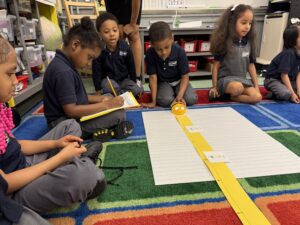
The other day, a school leader shared a story that stopped me in my tracks. A kindergarten scholar was crying at dismissal. When asked what was wrong, the student wasn’t upset about leaving friends or a scraped knee—they were heartbroken because they had to leave early and would miss working with their Bee-Bot robot.
When was the last time you saw a five-year-old cry because they couldn’t do their science and computing schoolwork?
This level of engagement isn’t a fluke; it is the direct byproduct of a highly intentional, cumulative journey.
AI Literacy Is Part Of A Larger Puzzle
Uncommon Schools is taking a different, highly measured approach across our K-12 ecosystem. Supported by a grant and close collaboration with the Robin Hood Foundation Learning + Technology Fund, alongside the rigorous development work of our internal Uncommon AI Working Group, we are implementing a comprehensive, cohesive K-8 pathway designed specifically to build the foundational skills needed for advanced high school achievement. This curriculum treats AI literacy as an earned destination, intentionally integrating and reinforcing the essential competencies necessary for students to graduate into our 9-12 classrooms ready to use these technologies responsibly, effectively, and rigorously.
We do not view AI literacy as an isolated technical skill or a trendy standalone subject.
Instead, we know that AI literacy is just one piece of a much larger puzzle: the essential critical thinking skills required to be an informed digital citizen in the 21st century. At our core, we believe that AI literacy does not exist in a vacuum—rather, it is built entirely on the backs of media, data, and computation. Because of this conviction, our program roots AI literacy standards deeply within computational and data thinking, media literacy, source evaluation, and civics.
Building a K-8 Foundation To AI
Underpinning the elementary experience is a robust media literacy partnership with the Common Sense curriculum mapped directly into our existing academic courses. When a topic leans heavily into character education or social-emotional learning—like managing online behavior—we bring those lessons into our grade-level Circle assemblies to build culture and community safety simultaneously. Grade-by-grade, this foundation takes shape clearly:
- Kindergarten & 1st Grade Concrete Integration: Students integrate computer science with life sciences. Using physical, kid-friendly Bee-Bot robots, students model how bees and plants depend on each other, learning sequencing, debugging, and spatial math.
- 2nd Grade Data & Computational Basics: These same physical robots transition into tools for data literacy and computational thinking. In our “Bee-Bot Data Olympics,” students practice decomposition and abstraction—learning to break down complex obstacles, strip away unnecessary details, and analyze trial data from robot runs to refine their code.
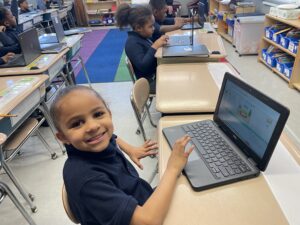
- 3rd & 4th Grade Abstract Screen Programming: Students seamlessly transition from physical robots to digital screen programming using Code.org’s CS Fundamentals. As Ki’Mora Miller, one of our 3rd-grade teachers, shared, “Students are highly engaged and enjoy the hands-on opportunities to problem solve, collaborate, and think creatively. Coding has helped strengthen perseverance, critical thinking, and productive struggle in a fun, interactive way.”
As scholars enter middle school, this foundational work scales up into rigorous data literacy, heavy-hitting source evaluation, and scientific inquiry to prepare them for advanced academic expectations:
- 5th Grade Human-Generated Media Analysis: Before students can critique AI-generated content, they must learn to analyze human-generated media. In a recent eco-dilemma research unit, our 5th graders stepped into the role of advisors, investigating an invasive beetle that was destroying local trees. Instead of blindly trusting online sources, students applied the “SIFT” method to evaluate credibility—detecting bias in social media posts, checking dates, and corroborating claims before crafting an evidence-based recommendation to a local mayor.
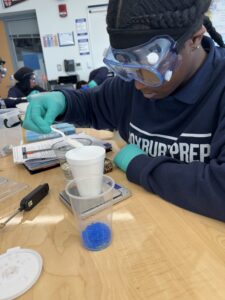
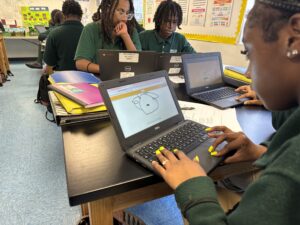
- 6th Grade Authentic Tools & Data Gathering: The technical complexity ramps up as students use micro:bits—pocket-sized computers—to directly integrate computer science skills into their core science classes. Rather than teaching computing in isolation, our scholars use technology as an authentic tool to investigate, measure, and analyze data from the physical world around them.
- 7th & 8th Grade Sophisticated Data Management & AI Systems: Students receive targeted lessons to ensure they know how to collect, visualize, and interpret data seamlessly. In 8th-grade science, this data literacy becomes highly sophisticated; scholars analyze real-world climate records and centuries-old ice core datasets to track planetary human impact. Learning to manage and interpret these massive, authentic datasets provides the ultimate cognitive scaffolding for their concurrent 7th and 8th-grade AI literacy units. Because AI is powered by the data, media, and code they have studied for years, they are uniquely equipped to understand how these systems operate.
 Ethics Is The Differentiator
While anyone can teach a child to use an AI tool, our mission is to teach students to critique them. Our 8th graders examine algorithmic bias, privacy concerns, fairness, and the sourcing of diverse data. They evaluate sources and question the civics of technology. This ethical framework culminates in a community-minded design project where teams brainstorm an AI solution with defined users, goals, risks, and success metrics.
We are not just teaching kids how to consume tech or write lines of code. By embedding AI literacy within a broader web of ethical, critical thinking, we are ensuring our scholars are fully ready for the unique, cutting-edge rigor of high school classrooms like Taubman’s and Kern’s. We are ensuring they will not just navigate the emerging world of AI—they will lead it with conscience and character.

 French
  English
  Arabic
  Chinese
  Portuguese
  Spanish
  Haitian Creole