

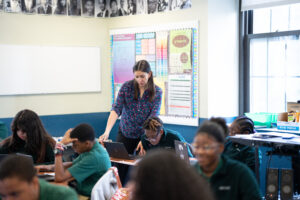
Eighth-grade math teacher Katherine Goett always has a math joke ready for her students at Downtown Middle School (DTMS). On this day, she tells several.
Q: “What’s a bird’s favorite math class?”
A: Owl-gebra.
It’s a fitting joke for an Algebra I teacher whose students boasted the highest passing rate in the Uncommon Schools-North Star network—100% of Goett’s 42 students scored proficient on the New Jersey Student Learning Assessment (NJSLA) in 2024. They outperformed their Newark peers by a huge margin (81%), and outpaced non-economically disadvantaged peers by double digits (50%).
These results are even more striking when the grade level of Goett’s students is taken into account. The average student takes Algebra I in high school; Goett’s middle schoolers take it a year or years earlier—and do better. The veteran math teacher attributes her students’ success to a few key factors: a deep love and knowledge of the content, strong instructional practices, and a healthy dose of joy.

A STEM Kid Follows Her Dream
A native of New Jersey, Goett comes from a family of educators. Her mother is a retired math teacher.
“I grew up loving STEM,” she said. “Especially math and science.”
Goett pursued her passions at the University of Notre Dame, taking enough credits to earn the teaching endorsement in math that would launch her career. She taught in Indiana for several years before joining Newark’s North Star Academy in 2012 as an 8th-grade math teacher at DTMS, where she has taught ever since.
Currently in her 17th year of teaching, Goett is an unapologetic 8th-grade enthusiast. “I like the content better. And eighth graders tend to rise to being the leaders of the school.”
But middle school is not the only opportunity that her students have to rise to the occasion: taking a high school-level Algebra course as an 8th grader requires a certain amount of grit. Goett keeps the journey accessible by centering her instruction on the foundational knowledge of key algebraic concepts and supporting students as necessary.
“I think the biggest misconception [that students have] is that it’s going to be really challenging.” Goett explained. “And I think they realize, when you take it day by day, the lesson that you saw in September that looked like a different language, suddenly you understand it.”
These ‘a-ha’ moments are common in Goett’s class, and she sees each one as teaching students something important about themselves. “Looking at something that appears scary or abstract but knowing that you can figure it out and overcome it shows a lot about what you’re capable of doing,” she added.
Students who can fluently and flexibly grapple with algebraic content in middle school are more likely to take challenging courses, like Calculus, in high school and pursue STEM fields in college.
But building a solid base of knowledge and ability takes time, and Goett makes the most of it.
Here is an exemplar of Goett showcasing side by side math problems to show to encourage students to figure out the answers and take ownership of their own learning. Video Discourse: Side by Side Show Call

Devote Teaching Time to What Matters Most
A visit to Goett’s classroom reveals strong instructional practices at work. She credits academic monitoring (where she analyzes student work during independent practice) and student discourse with helping her students make sense of the advanced content.
“We have an Explore problem that’s based on prior knowledge. Kids have to solve it by applying or creating a rule. So I step back and give the kids a chance to figure things out on their own. I walk around, look at student work and plan in my mind: who’s almost there, who has it, and who could benefit from seeing someone else’s work” she said.
From there, Goett posts student work in a show-call and calls on students to discuss it in turn-and-talks or as a class. Simple questions drive the conversation. Goett prefers universal prompts like, “What do we notice?” and “Do you agree?” to keep the cognitive load on students. Best practices like these are commonly modeled and practiced in Uncommon’s weekly professional development sessions.
“My mantra is ‘student talk is greater than teacher talk’,” Goett said. “It’s an inequality. Kids are going to remember what they talked about and debated rather than just listening to me.”
Nonetheless, what students are most likely to remember is how Goett made them feel.
Here is an exemplar of Goett encouraging students in math discourse to internalize the lesson. Video Classroom Discourse.

Make Joy an Essential Takeaway
Goett’s classroom brims with joyful rigor. Students regularly compete in Math Olympiads where the winners are medaled to the tune of the Olympic theme song. And there are other bright spots: Goett often creates challenges and competitions to reward students for their engagement and mastery. The lucky winners receive home-baked brownies.
Goett doesn’t do this just to invest students in Algebra; it’s part of who she is.
“I think it’s important to show kids that you love what you do,” she said. “And that you’re happy to be there every day—it’s such an integral part of being an effective teacher.”
Which brings us back to the math jokes.
Goett shows a colorful printout of an addition and a subtraction sign.
“Are you sure I make a difference?” The subtraction sign asks.
“Positive,” the plus sign says.
As she readies her current 8th graders for the NJSLA, Goett looks ahead to the future. In June she will complete her time at the Master Teacher Institute (MTI), a year-long professional development program that Uncommon offers to experienced, effective K-12 educators. Learning in community with fellow teachers has pushed her practice. While she won’t receive the results of the 2025 NJSLA for some time, Goett knows that students have learned more than just Algebra.
“Such a big part of math is looking at your work, finding mistakes, making corrections and then moving forward with that new skill.” Goett said. “It’s very relatable to life outside of math class.”

 Portuguese
  English
  Arabic
  Chinese
  French
  Spanish
  Haitian Creole